My afternoon brain fog used to be so predictable I built my schedule around it.
Block off 2pm to 4pm. Do nothing important. Wait for it to pass. I assumed it was the post-lunch blood sugar crash — too much rice, too much roti, the usual suspects. So I cleaned up the carbs. Still foggy. I cut the coffee. Still foggy.
Then I started paying attention not to how much I was eating, but to how many different things I was eating. Turns out that number was over 30. And understanding why that number matters changed how I think about every meal I eat.
Your gut is not just a digestive organ
Most people treat the gut as plumbing. Food goes in, waste comes out, nutrients get absorbed somewhere in the middle.
The reality is considerably more interesting. Your gut contains roughly 38 trillion microorganisms — bacteria, fungi, viruses, and other microbes — collectively called the gut microbiome. These organisms are not passive passengers. They produce vitamins, regulate your immune system, influence how your body stores fat, and communicate directly with your brain.
The diversity of this microbial community turns out to be one of the most important markers of overall health. A diverse microbiome is associated with lower rates of chronic disease, better immune function, more stable blood sugar, and, as I eventually discovered, clearer thinking. Low diversity is consistently linked to obesity, type 2 diabetes, inflammatory conditions, and mental health disorders — a pattern that shows up in the research with uncomfortable regularity for South Asian populations specifically.
The 30-plant finding that changed how I grocery shop
In 2018, the American Gut Project published results from one of the largest microbiome studies ever conducted — over 10,000 participants across the US, UK, and Australia. The finding that stuck: people who ate 30 or more different plant foods per week had significantly more diverse gut microbiomes than those eating fewer than 10.
What made this interesting was not just the number but what it implied. The researchers found that plant diversity had a greater impact on microbiome composition than whether someone was vegan, vegetarian, or omnivore. The label mattered less than the variety on the plate. Different plants feed different bacteria — eat the same seven vegetables every week and you effectively starve the species that thrive on what you’re not eating.
Here is what counts toward your 30: fruits, vegetables, legumes, nuts, seeds, and wholegrains — each variety as a separate plant. Herbs and spices count too, at a quarter point each. A handful of walnuts is one plant. A bowl of moong dal is another. Refined plant products — white rice, white bread, fruit juice — do not count, because processing strips out the fibre that gut bacteria actually need.
For a desi kitchen, 30 is surprisingly achievable. The traditional Indian pantry — dal varieties, chana, methi, jeera, haldi, ajwain, saunf — was microbiome-rich long before researchers had a word for it. The problem is not our food heritage. The problem is what happens to it when we move to the US.
The desi gut: why our microbiome faces a particular challenge
Research shows the Indian gut microbiome is compositionally distinct from Western populations — shaped by thousands of years of a high-plant, high-spice, plant-protein-forward diet. A landmark study found it is enriched in genes for breaking down complex polysaccharides: our ancestral microbiome evolved to process a wide variety of plant matter efficiently.
The challenge is what happens after immigration. Traditional variety disappears. Dal gets replaced by convenience food on busy weekdays. Ultra-processed food creeps in. The microbiome, built over generations, gets disrupted within years.
The downstream consequences are not abstract. Rates of type 2 diabetes, metabolic syndrome, and inflammatory conditions rise significantly in South Asians after immigrating to Western countries — at BMIs that would not trigger concern in a Western clinical reference range. Gut dysbiosis is increasingly cited as a contributing mechanism. The good news: the microbiome is more responsive to dietary change than almost any other biological system. It begins adapting within days.
What 30+ plants actually looks like on a weekly plate
Here is my honest weekly inventory.
Morning shake (daily, with rotation): Banana as the base, then a rotation across blackberries, strawberries, blueberries, mango, apple, and pear. Seeds rotate between chia, flax, and pumpkin. That is nine to ten full plant points before I have left the kitchen.
Sprouts (three to four times a week): Moong, chana, and broccoli sprouts in rotation — each a distinct plant. Broccoli sprouts deserve a specific mention: they are one of the most concentrated sources of sulforaphane, a compound that recent research shows actively rebuilds microbial diversity and supports gut barrier integrity. A 2025 Nature Microbiology randomised controlled trial found broccoli sprout extract measurably improved fasting blood glucose in prediabetes. The sprouts you grow in a jar on your kitchen counter are doing more than you probably realise.
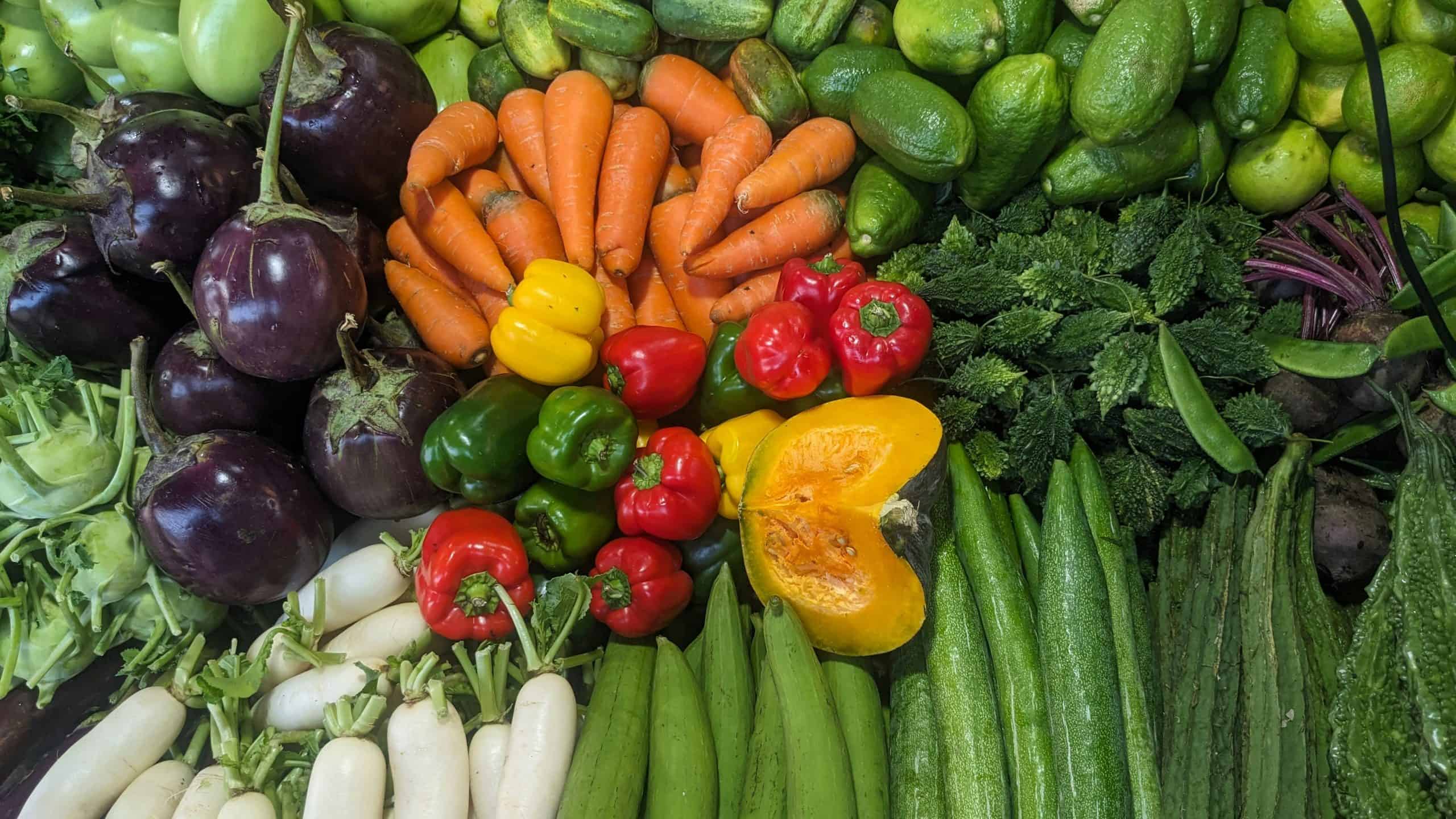
Vegetable rotation: Potato, sweet potato, spinach, arugula, cauliflower, broccoli, carrots, tomatoes, kale, bhindi, onions, spring onions, radish. I aim for colour coverage — something orange, something dark green, something cruciferous, something allium. A colourful plate is not just visually appealing; colour in produce correlates with polyphenol diversity, which correlates with microbiome diversity.
Fruit through the week: Plum, apricot, amla (gooseberry). Amla in particular is one of the most polyphenol-dense fruits available and deeply rooted in the desi kitchen — yet most of us in the US have stopped eating it. It counts as a full plant point and should count more often.
Nuts daily: Walnuts, almonds, cashews, pistachios — each a separate plant. Citrus: Lemon and lime daily in water, on food, in dressing.
Fermented foods: This is where most desi diets have the biggest gap — including mine, until recently. Plant fibre feeds the microbiome; fermentation adds live bacteria directly to it. A landmark Stanford clinical trial found that 10 weeks of high-fermented-food consumption increased microbiome diversity and reduced 19 different inflammatory markers. I eat kimchi several times a week — the Korean diaspora got here first on this one, and I followed the evidence — and Greek yogurt most mornings. If you eat dahi, you are already there. Genuine lacto-fermented achaar counts too; vinegar-brined supermarket pickle does not.
On spices: jeera, haldi, ginger, coriander, methi, ajwain each contribute a quarter plant point. They are not the foundation of the count — my weekly total from whole foods alone clears 30 — but they are real credit that most desi cooks are already collecting without knowing it. On a week when I cook with eight different spices, I have added two full plant point equivalents before I have thought about it. The traditional kitchen was designed, without knowing it, around exactly this principle.
The brain connection: why “gut feeling” is not a metaphor
Here is the part I found most surprising, and that now makes the brain fog story make complete sense.
Approximately 90% of the body’s serotonin — the neurotransmitter most associated with mood regulation, emotional stability, and cognitive clarity — is produced not in the brain but in the gut. It is synthesised by specialised cells in the intestinal lining and transmitted to the brain via the vagus nerve, a neural highway running from the brainstem directly into the digestive tract.
Gut bacteria play a direct role in this. They produce short-chain fatty acids — the metabolic byproducts of fermenting plant fibre — which enhance the enzyme activity required for serotonin synthesis. A microbiome depleted of diversity produces fewer of these fatty acids. The signal travelling up the vagus nerve to mood-regulating regions of the brain is diminished.
This bidirectional microbiota-gut-brain axis integrates neural, immune, endocrine, and metabolic pathways. A 2025 systematic review found dysbiosis associated with depression, anxiety, cognitive decline, and impulsivity. The gut is not a passenger in mental health. It is an active participant.
My afternoon brain fog did not disappear overnight. It shifted gradually, over several months, as I rebuilt the variety and consistency of what I was eating. I cannot give you a p-value for that. But I can tell you that the 2pm block no longer appears in my calendar.
How to get to 30 — without a complicated protocol
The threshold is 30 per week, not 30 per day. The pressure is lower than it sounds.
Count variety, not quantity. A single walnut counts as much as a full serving. The microbiome cares about diversity, not volume.
Rotate deliberately. Most of us buy the same produce every week. Change one item — different berries, different lentil, different nut. The microbiome notices.
Let the desi pantry work for you. Count your legumes separately — toor dal and masoor dal are different plants. Count your sprout varieties. Count your nuts individually. You may already be closer to 30 than you think.
Add fermentation. Dahi every day, or kimchi, or genuine lacto-fermented achaar. One serving. Consistently.
Make the plate look like something. If the plate is beige, it is not diverse. Aim for four colours — not as a rule, as a prompt. The instinct to make food look good turns out to be nutritionally sound.
If you want to go deeper: At-home microbiome tests have matured significantly. Viome is one of the most established — it uses RNA sequencing rather than standard DNA, so it can tell you not just which microbes are present but what they are actually doing. Treat the results as a directional signal rather than a clinical diagnosis. Most people who have done it found it useful not for uncovering something alarming, but for confirming which habits were working. If you are already eating 30+ plants and fermenting consistently, you may find the results pleasantly unsurprising.
The gut microbiome is not a niche topic for biohackers. It is the operating system running beneath every other system in the body — immune, metabolic, neurological. Feed it variety. Give it fermentation. Let the desi pantry, which was microbiome-rich before we had a word for it, do what it was always designed to do.
Thirty plants a week. Start counting and you will be surprised how close you already are.