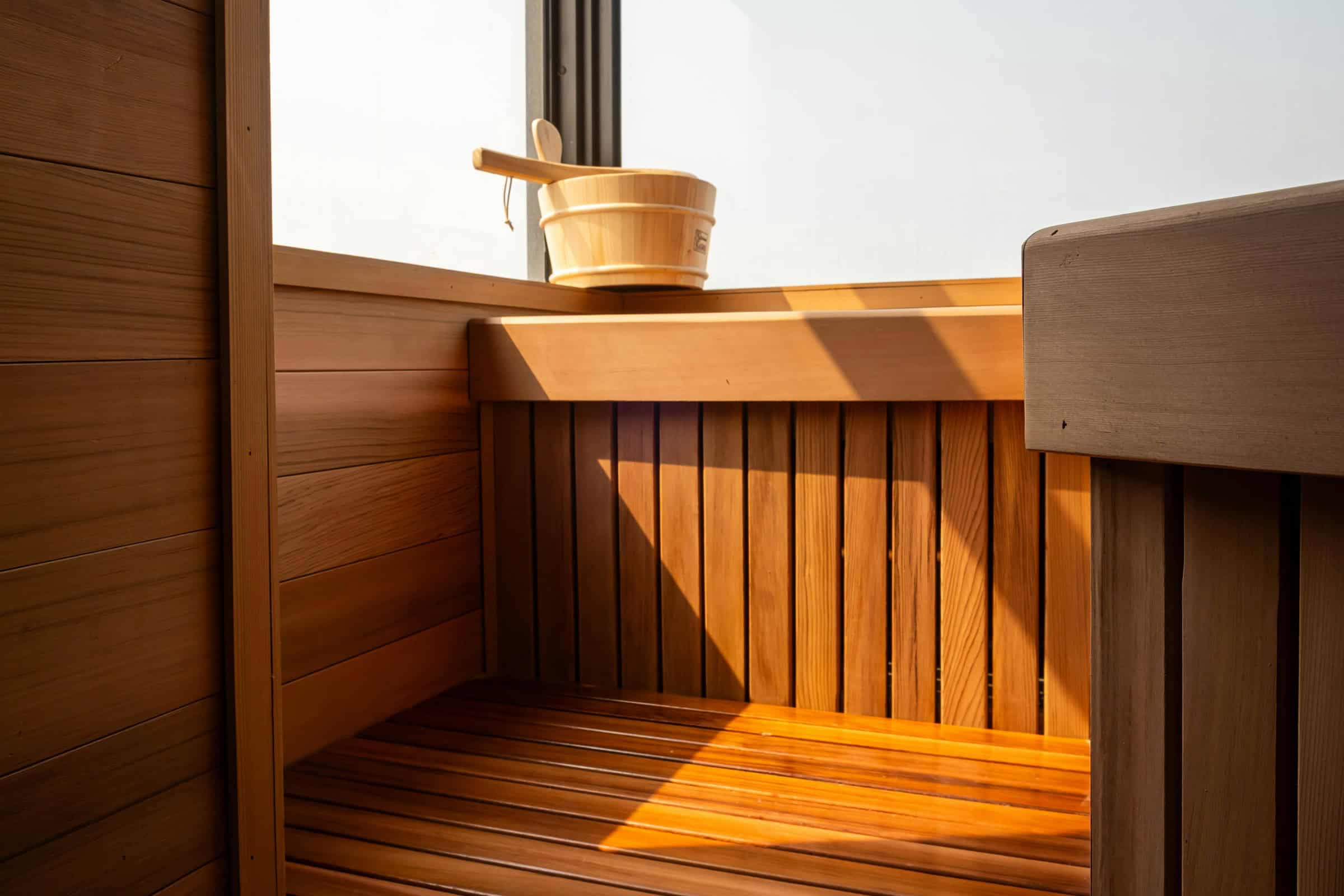
Eight weeks ago I bolted a cedar box to a corner of my backyard, ran a 240-volt line to it, and started sitting inside it at 168°F for fifteen minutes after I lift.
I want to be honest about why. It wasn’t a wellness whim. My genetic panel flags me at very high risk for high blood pressure, with salt sensitivity stacked on top. My family tree agrees with the lab. So when I kept running into the same name in the longevity research — a Finnish cardiologist named Jari Laukkanen — I stopped scrolling and started reading. Then I bought a sauna.
Two months in, two things are true. My Oura HRV is trending up, and my legs are less wrecked the day after a heavy lower session. I’ll get to how much of that I can actually credit to the heat (spoiler: less than I’d like). But first, the research, because it’s genuinely good — and genuinely misunderstood.
What the Finnish data actually shows
The study everyone cites is Laukkanen’s 2015 paper in JAMA Internal Medicine. His team followed about 2,300 middle-aged Finnish men for roughly two decades and sorted them by how often they used the sauna. The men who went 4–7 times a week, versus once a week, had dramatically lower rates of fatal cardiovascular disease, sudden cardiac death, and death from any cause. Later work from the same cohort linked frequent sauna use to lower rates of new high blood pressure, stroke, and even dementia and Alzheimer’s.
Those are big numbers, and this is where I have to put the brakes on — the same brakes I’d want you to keep your hand on.
This is observational data. These men chose how often they sauna’d; nobody randomized them. People who sit in a 190°F room five times a week are, on average, doing a lot of other things right, and researchers can only control for the confounders they thought to measure. Association is not the same as “sauna adds years to your life.” Laukkanen himself frames it carefully, and so should we.
The mechanism story is plausible: a 2018 review in Mayo Clinic Proceedings lays out how repeated heat may lower blood pressure, improve the lining of your blood vessels, reduce arterial stiffness, shift your nervous system toward “rest and recover,” and blunt oxidative stress. Sitting in heat makes your heart rate climb and your vessels dilate — it looks, hemodynamically, a little like light cardio you do sitting down.
But here’s the counterweight I keep on the desk, because it matters. There’s an 8-week randomized trial of Finnish sauna bathing in people with existing heart disease. After eight weeks, their bodies had clearly adapted to the heat — they sweated more efficiently, ran a cooler core temperature. And yet their endothelial function, arterial stiffness, and blood pressure didn’t measurably improve. Other work found single sessions don’t acutely improve vessel function in people who are already healthy. The benefit seems to concentrate in higher-risk people and in the accumulation of a years-long habit — not in a quick fix, and not in a lab-confirmed win after two months.
I’m exactly eight weeks in. That trial is my reminder not to oversell my own experiment.
Why this is a bigger deal for desis specifically
South Asians carry more cardiovascular risk, earlier, and at lower body weights than the reference populations most of this research was built on. We show up with heart disease at BMIs that would get a European wave-through. My own last panel makes the point without me having to editorialize: pristine metabolic health — A1c 5.2, fasting insulin under 5 — sitting right next to a rising ApoB and a lipoprotein(a) creeping toward the risk line. The metabolic engine is clean. The plumbing needs watching.
So a lever with real evidence for lowering blood pressure and easing arterial stiffness isn’t a nice-to-have for me. It’s aimed straight at the risk my genome wrote in ink. My genetic flags for blood pressure and for oxidative-stress handling — the proposed sauna mechanisms read like a list of my genetic soft spots.
I’ll flag the mechanism honesty here too: “reduces oxidative stress” is a proposed pathway, not something I’ve measured in my own blood, and heat as hormesis — a small, controlled stressor that trains your cells to defend themselves better, partly through heat-shock proteins — is a compelling idea that’s still more mechanism than proof. I’m using the research as a reason to try, not as a claim about what’s happening inside me.
There’s also a cultural point worth saying out loud. In a lot of desi households, sitting in heat reads as indulgence — a spa thing, a soft thing. It isn’t. The steam room instinct our parents had wasn’t wrong; it just never got connected to a cardiology cohort. This is the same idea, with a 20-year dataset behind it.
My actual protocol (and the salt-sensitive catch)
I keep it simple and repeatable:
- 168°F, 15 minutes, right after strength training. I’ll be straight that 168°F is on the gentle end — the Finnish studies ran hotter (176–212°F) and the strongest signal came from longer sessions. My frequency (4–5×/week) sits squarely in the beneficial band; my temperature and duration have room to climb, and I’ll build up rather than jump.
- Cool-down: a tall glass of water cut with LMNT, then a cold shower. The cold shower is the part I look forward to most, honestly.
That electrolyte step isn’t garnish, and here’s where being salt-sensitive gets interesting. Heavy sweating dumps sodium. For most people that’s fine to replace freely. For someone salt-sensitive and managing blood pressure, it’s a genuine balancing act — I need to replace what I lose to stay hydrated and avoid the post-sauna headache, without casually blowing past a sodium load my blood pressure doesn’t love. So I replace deliberately, not reflexively, and I’d tell any salt-sensitive reader to do the same and to loop in their doctor rather than free-pouring electrolytes because a podcast said to.
What I’m tracking: Oura HRV, resting heart rate, and how my legs feel 24 hours post-lift. HRV is trending up and soreness is down. But I did not run a clean experiment on myself — I also lift, sleep decently, take electrolytes, and cold-shower. I can’t hand the sauna the credit and keep a straight face. On the “less soreness” specifically: the controlled research on sauna and muscle soreness is thin and mixed, so treat my experience as one person’s felt data, not a proven effect. The mechanism (more blood flow, heat-shock proteins, plain relaxation) is reasonable; the evidence is not settled.
If you want to try it
You don’t need a backyard cedar box. A gym sauna works. Here’s how I’d start:
- Frequency beats intensity. The cohort signal was about how often, not how brutal. Two to three sessions a week is a real starting point; the 4–7× range is where the association got strongest.
- Start gentle, build up. 10–15 minutes at a temperature you can actually sit through, breathing easy. You can always add heat and time. Lightheaded is your cue to leave, not to tough it out.
- Hydrate with electrolytes — thoughtfully if your blood pressure runs high or you’re salt-sensitive. Water plus a sensible electrolyte replacement. If you’re on blood-pressure medication, talk to your doctor first: sauna lowers blood pressure acutely, and stacking that on medication can leave you dizzy.
- Skip it if you’ve been drinking, are pregnant, or have unstable heart disease. And if it’s a real hardwired unit like mine, get a licensed electrician — this is a 240V/50A appliance, not a plug-in.
- Measure your own response. This is the part I care about most. Don’t inherit my results or a Finnish cohort’s — watch your own HRV, your own resting heart rate, your own recovery. Borrow the research as a reason to start; let your own numbers tell you whether to continue.
I’m not going to tell you a sauna will add years to your life. The honest version is quieter: there’s a strong, decades-long association in exactly the risk categories my genes put me in, the mechanisms are plausible, the downside is low if you’re healthy and sensible, and it’s become the fifteen minutes of my day I most look forward to. For a lever aimed at the risks written into my DNA, that’s enough to keep the box hot.
I’ll report back when I have more than eight weeks of my own data.
This is my personal experience and a read of the published research, not medical advice. Sauna use carries real cautions — heart conditions, pregnancy, blood-pressure medication, alcohol. Talk to your own doctor before starting, especially if any of those apply to you.
