It’s 3pm. You ate lunch two hours ago. And yet here you are — foggy, irritable, staring at the pantry, convinced that if you don’t get something into your body in the next ten minutes you might not survive the meeting.
We call it the afternoon slump. We blame it on a bad night’s sleep, or too much work, or “I just need a coffee.” We reach for a biscuit with the chai, feel better for forty-five minutes, and crash again by five.
I did this for years. And I was completely wrong about what it was.
The 3pm crash isn’t a willpower problem. It isn’t a caffeine problem. It’s a signal — one of the clearest signals your body sends you — that a specific mechanism has stopped working properly. Your body has forgotten how to switch between its two fuel tanks. And once you understand that one idea, a dozen things you thought were unrelated — the constant hunger, the food coma after a rice-heavy lunch, the 3am wake-up, the “hangry,” the stubborn weight that won’t move — turn out to be the same thing wearing different clothes.
That mechanism has a name: metabolic flexibility. It’s the most important metabolic concept almost nobody explains in plain language. So let me try.
Two tanks
Your body runs on two fuels: sugar (glucose) and fat.
Think of them as two tanks. The sugar tank is small and fast — it fills up when you eat carbs and empties quickly. The fat tank is enormous and slow — even a lean person is carrying tens of thousands of calories of fat, a reserve that could power you for weeks.
A healthy body switches between these tanks all day without you noticing. You eat a meal, insulin rises, and your body burns the sugar that just came in. A few hours later, as that sugar clears and insulin drops, your body quietly switches over to the fat tank to keep you running until the next meal. Overnight, while you sleep, you’re running almost entirely on fat.
That clean, automatic switching is metabolic flexibility. In the research literature it’s defined as the capacity to switch from burning fat during fasting to burning glucose after you eat — and back again — depending on what fuel is available. A flexible body reads the situation and picks the right tank. Simple.
Here’s what happens when the switch breaks.
The stuck switch
Insulin is the switch operator. When you eat carbs, insulin goes up and tells your body two things at once: burn this sugar, and stop burning fat for now. That second instruction matters. As long as insulin is high, the fat tank is locked. You physically cannot access it.
In a flexible body, insulin rises after a meal and then falls back down a few hours later, unlocking the fat tank again. But when you eat refined carbs all day — and when your baseline insulin is chronically elevated — insulin never really comes down. The switch gets stuck in the sugar position. The fat tank stays locked, all day, every day.
Now the 3pm crash makes sense. You’re stuck burning sugar, your small sugar tank is running low, and your body can’t reach the giant fat reserve sitting right there because insulin won’t let it. So you crash. And your body does the only thing it can: it screams at you to eat more sugar. That’s the hunger. That’s the “hangry.” You’re not weak. You’re locked out of your own fuel.
Over time this stuck state has a name too — metabolic inflexibility — and the research ties it directly to insulin resistance, type 2 diabetes, obesity, and cardiovascular disease. Which is exactly why I care about it, and why you should too.
Why I know my switch works: a Tuesday, a ketone meter, and 1.2
Here’s the part I want to be honest about, because it’s the whole point.
I am not on a keto diet. I eat rice. I eat roti. I eat dal, fruit, the works. Carbs are a normal part of my week.
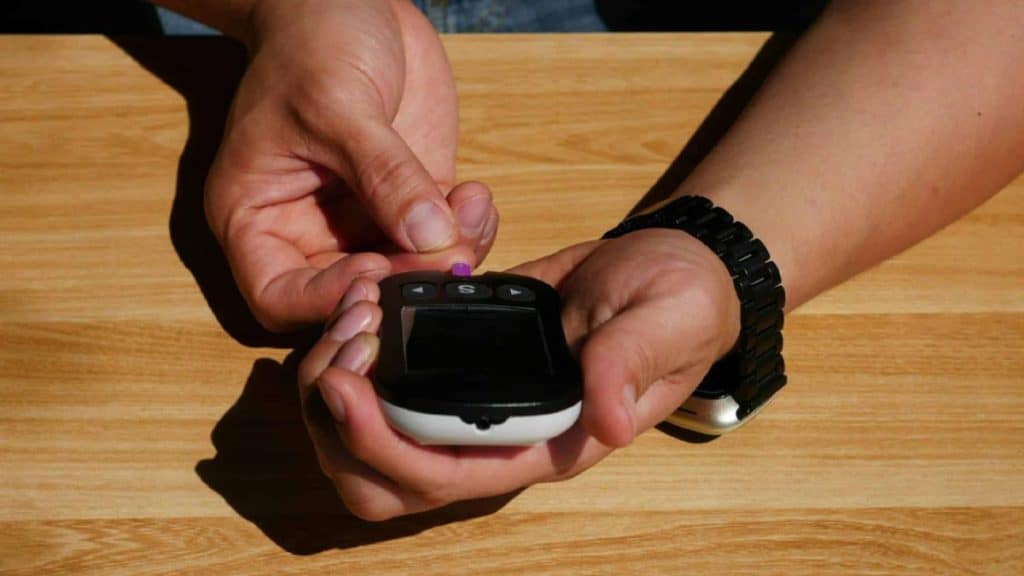
But on weekdays I run a simple fast: dinner at 6:30pm, then nothing until a protein smoothie at 10:30am the next day. That’s a sixteen-hour gap — the standard 16:8 window. Somewhere in the middle of it, I work out in the morning, fasted, with a shot of espresso as my only pre-workout. (Black espresso is calorie-free, so it doesn’t break the fast — and the caffeine actually nudges fat-burning along.) Then, out of curiosity, I sometimes check my blood ketones with a little meter before I break the fast. Ketones are what your liver produces when you’re genuinely running on fat. If your body has switched to the fat tank, ketones show up in your blood. If it hasn’t, they don’t.
By mid-morning — sixteen hours after dinner, after a fasted workout, right before that smoothie — my meter reads 1.0 to 1.5 mmol/L.
That’s the switch working. That number means my body — with no keto diet, no special food, nothing but a sixteen-hour gap and a morning workout — flipped itself over to the fat tank and started producing ketones on its own. It read the situation (“no food coming in, and now we’re moving”) and reached for the big reserve, exactly like it’s supposed to.
An inflexible body can’t do this. Give a metabolically stuck person the same fast and their ketones barely move, because their insulin stays high and the fat tank stays locked. They just get miserable and hungry. Same fast, completely different result — because the machinery underneath is different.
One honest caveat, because this is a health publication and not a supplement ad: a ketone reading is a directional signal, not a clinical test. The gold-standard measures of metabolic flexibility are things like respiratory quotient testing or fasting insulin — this isn’t that. But as a cheap, at-home way to see your fuel switch actually flip? It’s a genuinely useful window. And watching that number appear was the first time this stopped being an abstract concept for me and started being something I could measure.
Why desis lose the switch early
Here’s the uncomfortable part, and the reason this article lives on MetabolicDesi and not some generic wellness blog.
South Asians tend to develop insulin resistance earlier and at lower body weights than other populations. You know the pattern — the “skinny-fat” thing, thin arms and a soft middle, the relative who “isn’t even overweight” but gets a prediabetes diagnosis at 38. That’s metabolic inflexibility showing up early, at a body weight that looks fine on the outside. The switch can get stuck long before the scale gives you any warning.
And our food, honestly, is built to keep the switch stuck. I don’t say this to be preachy — I grew up on this and I love it. But look at a typical day: maida biscuits with chai in the morning, white rice mountains at lunch, mithai at every wedding, festival, and Tuesday-because-someone-brought-it-to-the-office. It’s a stream of rapidly digesting carbs that keeps insulin elevated from morning to night. Every one of those sugar floods is another instruction to lock the fat tank. Do that for twenty years and your body forgets the switch exists.
So we get the double hit: a genetic tendency toward insulin resistance and a food culture that pours fuel on exactly that fire. That’s not a reason to panic. It’s a reason to understand the one thing underneath it all — and then do something about it. Which, thankfully, we can.
The good news: the switch is rebuildable
This is the part that actually matters, so I’ll be specific. Metabolic inflexibility is highly reversible with lifestyle changes. You can teach your body to switch again. Here are the levers, roughly in order of power.
1. Movement is the biggest lever — and you already have the two tools. Nothing rebuilds the fuel switch like exercise, because exercise forces your muscles to burn fuel efficiently again. Two kinds matter most, and they happen to be the two I keep writing about. Zone 2 cardio — that easy, conversational, still-able-to-talk pace — directly retrains your body’s fat-burning machinery and improves insulin sensitivity. Strength training builds muscle, and more muscle means more places to park glucose and a higher baseline burn. You don’t pick one; they stack. (I’ve written separately about my Zone 2 approach and about progressive overload — both are really doing the same underlying job: unsticking the switch.)
2. Give your body a real gap between meals. You don’t need a sixteen-hour window like mine. But reducing refined carbs, adding fibre, and simply leaving a longer gap between dinner and your first meal are three of the most evidence-backed ways to restore flexibility — no supplements, no equipment. The mechanism is obvious once you see it: if insulin never comes down, the fat tank never unlocks. A genuine gap lets insulin fall and hands your body the chance to reach for fat. And if you move during that gap — even a walk, let alone a fasted workout — you speed the switch along, because exercise drains the sugar tank and pushes your body toward fat faster. That combination is exactly why my ketones climb on a fasting morning.
3. Sleep and stress are metabolic factors, not “lifestyle” ones. This is the line that ties everything on this site together. A single night of short sleep measurably worsens insulin sensitivity the next day. Chronic stress keeps your system in sugar-burning, fat-locking mode. So the sleep and stress work — the HRV, the wind-down, all of it — isn’t a separate project from your metabolism. It’s the same project. Every pillar I write about here, Nutrition, Movement, Sleep, Stress, Recovery, is ultimately in service of this one underlying capacity: keeping your fuel switch working.
Where to start this week
You don’t fix twenty years of a stuck switch in a weekend, and anyone who tells you a single food or hack will do it is selling something. Metabolic flexibility is rebuilt slowly, which is genuinely good news, because it means small, boring, repeated things work. Pick one:
- Take a ten-minute walk after your biggest meal. It blunts the glucose spike and starts nudging the switch. Easiest possible entry point.
- Push your first meal thirty minutes later than usual. Not a fast. Just a slightly longer overnight gap to let insulin come down.
- Swap one refined-carb hit for protein or fibre — the chai-biscuit for chai and a handful of nuts. One swap. Not the whole diet.
- Guard one night of real sleep like it’s a metabolic intervention, because it is.
That’s it. The 3pm crash isn’t your character. It’s a switch that got stuck — and switches can be unstuck.
This content is for educational purposes only and is not medical advice. Individual metabolic responses vary, and the signals described here are directional, not diagnostic. If you’re managing a metabolic condition or considering significant changes to how you eat or fast, talk to your doctor first.